Visar inlägg med etikett familyhistory. Visa alla inlägg

tisdag 26 augusti 2014

Tuesday's Tip - Records from Mental Hospitals

There has ben mental hospitals in Sweden as far back as the middle ages. There are several musuems that show how the insane were treated and what life was like at the hospiatls and asylums. (link to list of museums).

Säter


A lot of the people treated at the hospital were women with frail nerves. If a woman was not happy taking care of her home she could from the beginning of the 20th century get electrical shock treatment.

If you find somebody in your family who spent time at one of these hospitals or asylums their journals can be found at the County Council archives. The journals tell the story of why the patients were taken care of, if they had been treated there or some where else earlier and which kind of medication that was given. The law about confidentiality, that everything is kept sekcret for 70 years, does not always apply to journals of this kind. The confidentiality is tried for each case and it depends on who is asking for the journals. But after  70 years they are available for everybody.

The records from the mental hospital Säter, for instance, is kept at Dalarna's County Council archives. Säter is probably one of Sweden's most famous mental institutions and is situated in Skönvik. It was built after a survey in 1902 determined that the counties of Gotland, Jönköping, Kopparberg, Kronoberg and Värmland had a high rate of insanity and amentia. Säter's Hospital opened in 1912 and was at the time one of Sweden's largest and most modern mental hospitals with 37 buildings. 20 of these were for taking care of up to 830 patients. The same year the "permanent" pavilion opened for the most dangerous patients. Several additions were made during the years and in 1975 the old main building from 1912 was torn down and replaced after huge restorations had been made to the rest of the hospital. In 1989 the "permanent" pavilion was closed down.


Tub for cold baths at Säter.
Photos used with permission from the photographer. More of her photos can be found at http://amateaur.se/

Source: http://sv.wikipedia.org/wiki/S%C3%A4ters_sjukhus
"Släkt" a magazine for Swedish genealogists. Year 32, no 5, 2013

Your Swedish Heritage http://linnlinns.wix.com/swedish-heritage Facebook: https://www.facebook.com/yourswedishheritage Instagram: http://instagram.com/yourswedishheritage Twitter: https://twitter.com/swedheritage Google +: https://plus.google.com/u/0/107062009006289990073/posts Pinterest: http://www.pinterest.com/urswedishherita/ Blog: http://yourswedishheritage.blogspot.se/

måndag 25 augusti 2014

Mystery Monday - Noak Larson from ?


Two years ago a man contacted me through Ancestry. He had been searching for information about his great grandfather Noa Larsson who had emigrated to the states from Sweden in 1891. I had a Noak Alexandersson born in 1869 in Lidhult, whose father's last name was Larson. Could these two be the same person? Sure looked like it. I did not have time at that moment to look further into the matter and we did not have any more contact about it.

Then, a few weeks ago, I got a new message from Noah's great grandchild, saying that he was coming to Sweden and asking if we could meet. So last Friday he came to Halmstad and I showed him around. We talked about Noah and what we thought were our joint relatives. The day after we planned to go to Lidhult, Odensjö and Femsjö where our ancestors had lived. But something did not add up... and it bothered me.

When I came home that evening I started looking into that side of my family tree and it turned up that I had not looked into it at all. When I met Noah's great grandchild the next day I told him that I had some bad news and some good news. The pad news was that my Noak and his Noah were not the same, mine never left Lidhult. The good new was that I thought that I had found his Noah, and he was born in the to Odensjö neighbouring parish Torpa. First I had thought that to find Noah's origins would be to look for a needle in a hay stack. Turns out that in the late 1860's it was only common in the area around Ljungby in Kronoberg Couty to name your children Noak and in 1868 there was only one Noak born in Sweden whose father was named Lars. Turns out that Noak's mother was born in Femsjö where we had planned to go and her father was born in Lidhult, where our original plans also would take us. But I was still not a hundred percent sure. We visited the village of Lidhult before going to Torpa. We visited the church where Noah probably had been christened and we also found the village where he was born and grew up. After that we visited some of my relatives where we had traditional Swedish fika - coffe, cinnamon buns, spunge cake and seven kinds of cookies. Our trip then took us to the village of Odensjö on the shores of Bolmen, followed by lunch at Tiraholm by the same lake. Our final destination was the village of Femsjö where we learned about Elias Fries who gave latin names to mushrooms, much like Carl Von Linné gave names to other plants.

That evening I continued my research on Noah and together with his great grandchild we managed to confirm my suspitions that his Noah was born in Torpa in 1868. Felt really good to know that his trip to Halland and Småland had not been in vain. And with his ties to Lidhult, Torpa and Femsjö the probabilaty that we are related in some way are really high.

So this is a genealogy mystery that I managed to solve. :)

Your Swedish Heritage http://linnlinns.wix.com/swedish-heritage
Facebook: https://www.facebook.com/yourswedishheritage
Instagram: http://instagram.com/yourswedishheritage
Twitter: https://twitter.com/swedheritage
Google +: https://plus.google.com/u/0/107062009006289990073/posts Pinterest: http://www.pinterest.com/urswedishherita/

måndag 7 juli 2014

Varberg Fortress

The rock that the fortress is built on has been used for guarding the inhabitants since prehistoric times. It was not untill the 13th century that a stronghold was built here when Jacob Nielsen, the owner of northern Halland, was accused of murdering the king. The northern parts of the castle is from that time.


 The wars between the Danish and the Swedes caused Varberg to change kingdoms eight times during the 14th century but the Danes won in the end and it remained Danish for almost another three hundred years. The defense of the castle had to improve and a fortress started to take shape in 1588.


The improvements contintued and about 1000 farmers worked each day, during 30 years. In 1618 it was one of the most modern defence buildings in Europe. It never had to be used as such however because in 1645 a peace treaty was signed between Denmarc and Sweden where Sweden got Halland.
The prison.
 The fortress was a military station untill 1830 when Karlsborg became a more important military base. The fortress had always housed prisoner but from 1548-1881 it was the home of around 400-500 interns at all time. In 1856 a real prison was built (see picture). The prisoners worked as stonemasons during their time in prison.


 During the 20th century the fortress became a museum but it also houses a bed and breakfast, a restaurant and buildings with apartments. The museum is the home of the famous Bockstensman (a bog man) and the button that supposedly killed king Karl XII in 1718.
One of the reenactors at the museum.

The outdoor café.
My personal connection to the fortress is my great great great [...] grandfather Mogens Mormand who was the commander on the fortress when it finally became Swedish. I do not know much about him but I plan to find out as much as I can.

My partner also has a personal connection. His great great grandfather was an intern after killing his wife with arsenic in hopes of marrying her sister. He was a prisoner in 1881 when it ceased to be a prison and was moved to Långholmen in Stockholm. I think he was finally let out as an old man. You can hear about him and also other prisoners in a short movie on the museum's web page, it is called Behind Closed Doors: http://www.hkm.varberg.se/english/

Sources:
http://veddige.nu/blogg/wp-content/uploads/VISKA_2006-3web.pdf
http://www.hkm.varberg.se/varbergs-fastning/

Your Swedish Heritage http://linnlinns.wix.com/swedish-heritage
Facebook: https://www.facebook.com/yourswedishheritage
Instagram: http://instagram.com/yourswedishheritage
Twitter: https://twitter.com/swedheritage
Google +: https://plus.google.com/u/0/107062009006289990073/posts
Pinterest: http://www.pinterest.com/urswedishherita/

fredag 4 juli 2014

Stavsjö in the county of Södermanland

My mother's cousin passed away in cancer so I want to write about something that is connected to him. I am going to write about the village where he, his father, and my grandfather grew up in.

The village of Stavsjö, situated between Norrköping and Nyköping south of Stockholm, mainly exists because of the ironworks that started its production in 1662. The ironworks was placed by the lake Stavsjön because of the natural resources of the area. In 1666 the production of canons started and became the main product for 200 years. Today the factory is still running and produces knife gate valves.
Stavsjö bruksmuseum - model of the village around 1900
The Russians attacked and burned down almost all of the village in the early 18th century but the ironworks was soon rebuilt. My great grandfather used to work at the ironworks and it was where my grandfather had his first job as a young teenager.

During the years 1898-1902 3000 arcres of forest was damaged by the black arches butterfly and a railroad was built to transport timber from the Kolmården woods down to the bay in the Baltic sea. The railroad-trasportation ended in 1939 when cars had become more common. Today you can walk or go by bike where the rails once were.

Kolmården station down by the bay.

Stavsjö station
The old canteen, that had also worked as an inn, of the ironworks was moved at the end of the 19th century and served as living quarters for the workers as well as housing a store on the bottom floor.
The old original part of the inn.
In 1947 the building once again became an inn under the current owner, counseler Julius Lindström. The mian road to Stockholm passed right outside the inn and it became a popular place for travellers to stop and have a bite to eat at. Traffic became heavier and heavier and the highway was moved a kilometer and the inn started to have troubles. It has stood empty for many years but in February renovations were being made in order to turn the inn into a place to house newly arrived immigrants who are waiting to know if they can stay or have to leave.

The restaurant

The conference and hotell section that was added in the early 1980's.

My grandfather's brother used to run the local gas station, right next to the inn, and my mom's cousin took over. When the highway moved so did the gas station and is one of Sweden's most visited gas stations.


Pictures:
Stavsjö bruksmuseum by Masugn  under license CC BY-SA 3.0
Kolmården station, Stavsjö station and the inn by Your Swedish Herigage

Sources:
http://sv.wikipedia.org/wiki/Stavsj%C3%B6
http://www.stafsjo.com/index.php?id=233
http://www.wikitree.com/wiki/Space:Stavsj%C3%B6_V%C3%A4rdshus

Your Swedish Heritage http://linnlinns.wix.com/swedish-heritage Facebook: https://www.facebook.com/yourswedishheritage Instagram: http://instagram.com/yourswedishheritage Twitter: https://twitter.com/swedheritage Google +: https://plus.google.com/u/0/107062009006289990073/posts Pinterest: http://www.pinterest.com/urswedishherita/ Blog: http://yourswedishheritage.blogspot.se/

måndag 30 juni 2014

The old Vinberg

A few days ago I wrote about the new church in Vinberg and promissed to tell you more about the village. Unfortunately some of my pictures seem to be missing.

Right next to the new church is the old vicarage. A beautiful old house built in 1799 in the same place as an earlier vicarage. It is the birth home of Olof von Dalin, a famous poet, and artist who was born August 29, 1708. He started the paper "Then Swänska Argus" which marks the beginning of the younger, new, Swedish language. He was made a noble man by the king.


The vicarage from Vicar Island.
 Olof grew up in the vicorage with his mother and step-father who created a beautiful park that has been somewhat restored and is open to the public. An island was created by digging a ditch from the river Vinån and ponds for fish has also been dug up again.

A gazebo build in 18th century style on the island.

An old well.
 Just across the road from the vicarage is the old cemetary, where the old church used to stand.
Entrance to the old cemetary.

A hedge marks where the old church used to stand.

"Here stood the church of Winberg from 1100-1900"

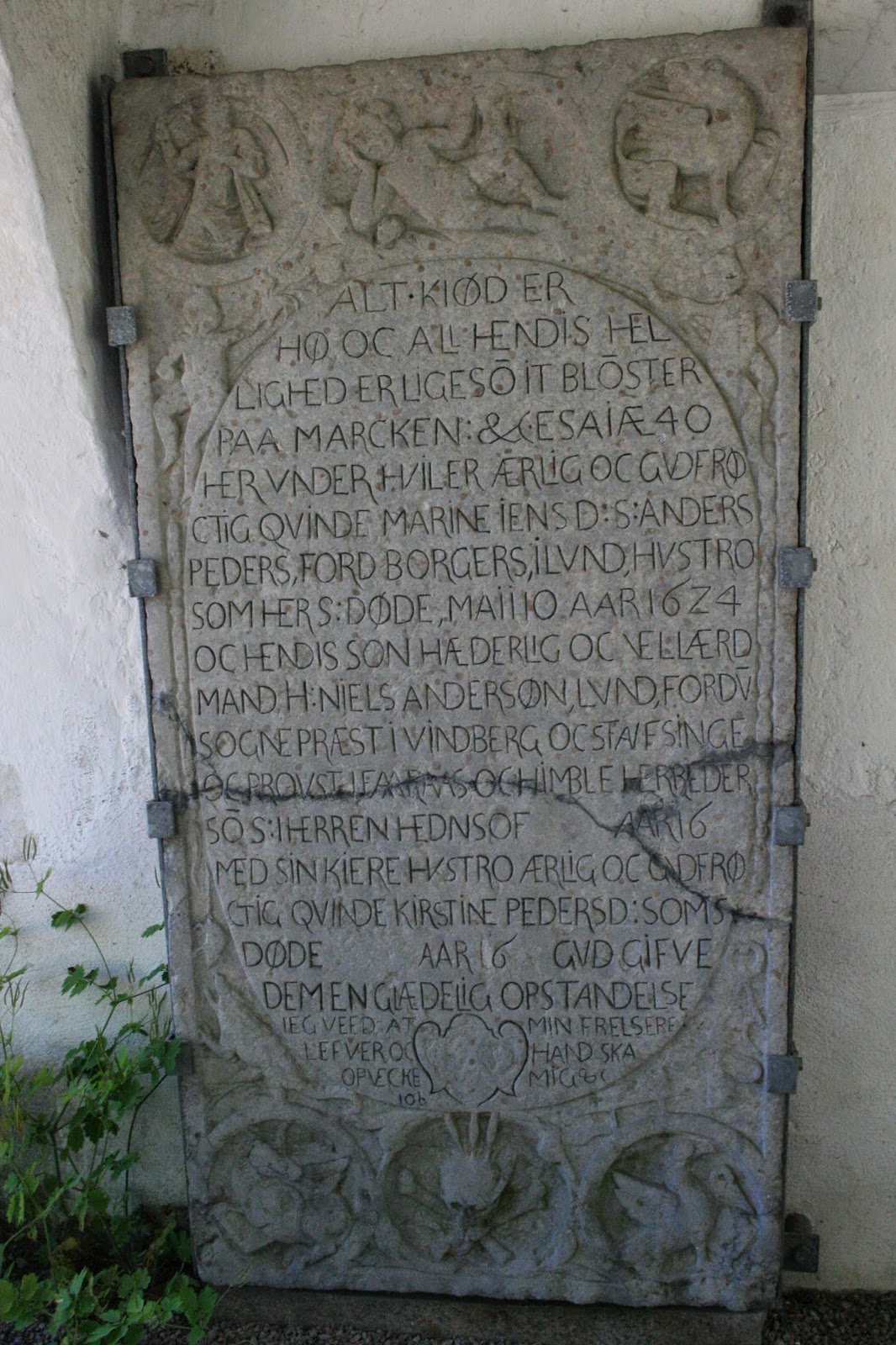
An old head-stone from 1624 when the province of Halland was Danish.

The old cemetary.

The new church in the distance.

An old water mill next to the cemetary.

List of all the head-stones and a map, showing who is buried where.
This old cemetary is a dream for any geneaologist with people buried here because in the entrance vault is a map and a file with a list of the graves and who is buried there.


Your Swedish Heritage http://linnlinns.wix.com/swedish-heritage Facebook: https://www.facebook.com/yourswedishheritage Instagram: http://instagram.com/yourswedishheritage Twitter: https://twitter.com/swedheritage Google +: https://plus.google.com/u/0/107062009006289990073/posts Pinterest: http://www.pinterest.com/urswedishherita/ Blog: http://yourswedishheritage.blogspot.se/

söndag 29 juni 2014

Crowning of Erick XIV June 29, 1561


Erik XIV was born December 13, 1533, as the oldest son of king Gustav Vasa and his mother was Katarina of Sachsen-Lauenburg. He was crowned king in the cathedral of Uppsala. His actions as king did not make his brothers or his nation happy and it led to Erik capulating to his brothers July 12, 1568. He was kept prisoner in different castles in Sweden and Finland until he died February 26, 1577, after eating pea soup. It is believed that he was poisoned by his brother Johan who had become king and research of his remains has shown that he had a high level of arsenic in his body when he died.

During his youth Eric spent a lot of time in Kalmar at the castle and it is worth a visit. There is a room that Erik partly decorated himself and he did the intarsia for the door. It was also here that he kept his mistress Agda Persdotter, which she was 1558-1561 and possibly 1563-1565. Their daughter Virginia was born in Kalmar January 1, 1559. Virginia had all the benefits of a legal child and was married to the nobleman Håkan Knutsson Hand. They lived in the parish of Odensjö in western Småland where their seven children were born and grew up. A lot of people in Sweden and all over the world are through these children related to Sweden's most famous king, Gustav Vasa. When I started with genealogy I learned about Virginia because Odensjö is where my father's father was born and grew up as a farmer's son. I thought that  maybe this would be my connection to royalty. It was not. I was very surprised when I found a connection through my mother's father who grew up in Södermanland. He came from a line of iron and marble workers and there was no knowledge about royal blood.

Erik and Agda's second daughter Constantia was born in Stockholm. Erik proposed to the queen of England, Elisabeth I but was turned down. Agda married Joakim Eriksson Frlemming but probably became Erik's mistress once again when she became a widow. All his mistresses were set aside once he met Karin Månsdotter. She was fifteen when she became his mistress and they got married July 4, 1568. They had a small quiet wedding and she was crowned queen the day after. The couple had however already gotten married in secret July 13, 1567. A lot of people were displeased with Erik's interest in Karin since she was not of noble birth but the daughter of a simple prison guard. Karin followed her husband in captivity and were freed after his death. She was given the farm Liuksiala in Finland and lived there the rest of her life.

Picture: Eric XIV of Sweden
Public Domain
By: Domenicus Verwilt
http://nationalmuseum.se/

Sources:
http://sv.wikipedia.org/wiki/Erik_XIV
http://sv.wikipedia.org/wiki/Agda_Persdotter
http://odensjohistoria.se/

Your Swedish Heritage http://linnlinns.wix.com/swedish-heritage
Facebook: https://www.facebook.com/yourswedishheritage
Instagram: http://instagram.com/yourswedishheritage
Twitter: https://twitter.com/swedheritage
Google +: https://plus.google.com/u/0/107062009006289990073/posts
Pinterest: http://www.pinterest.com/urswedishherita/

torsdag 26 juni 2014

Those Places Thursday - Varberg Coastal Sanatorium

Tuberculosis was a nationally widesperad disease at the beginning of the 20th century. Sanatoriums were built along the coast because it was believed that fresh air, salty baths and sun would cure the patients. In Varberg the medical officer was named Dr. J. S. Almer and he started the sanetarium at Apelviken, just south of Varberg, in 1902. Then it was very small but came to grow rapidly and when Almer died in 1927 it was the largest coastal sanatorium in Scandinavia with room for over 500 patients.

The hospital specialized in the sort of tuberculosis that people got from drinking milk that had not been pasturized. Small children were more often infected than grown ups and therefor it was mainly children who were treated at Apelviken. A vaccine was invented in the 1920's and in the 1950's the hospital closed as the last in the country.

Today the sanatorium has been turned into a health spa. It is protected since the enviroment is considered to be of cultural interest. Every thursday (at least during the summer months) a small guided tour is offered for free of the chapel, cemetary and outopsy room.

The chapel.

Inside the chapel.
A lot of children died at the sanatorium and not all of them were sent home. The ones buried at the cemetary are children from the most northern parts of Sweden. To send the bodies home cost too much and the parents could not afford it.

The cost of treating the patients were covered by the state, the county and the municipalities, so were the trips there and home. Some children spent years at the hospital, often in a cast when tuburculosis had gotten to the spine. Some got visits more often than others but those from the north seldom had visitors. There is a book with information about every person buried in the cemetary for those who are interested in knowing more about them.


The autopsy is right next to the cemetary. The guide explained how bodies never were moved during the day from their rooms. Instead they were transferred in the evening or early morning so that everybody would not have to see it.


Autopsy table

Autopsy table

Stretcher for moving corps and the guide.
The guide grew up in the area and knew a lot of the people working at the hospital. He himself got lung-tuberculosis as a child and spent some time at another sanatorium. He had many stories about the poeple who worked and were treated at Apelviken, both sad and happy ones.

The epedemics that reached several places all over the world during the beginning of the 20th century are hard to imagine for many of us but it is still reality in some parts of the world. It was also reality for many of our ancestors and therefor part of our personal history and genealogy.


Your Swedish Heritage http://linnlinns.wix.com/swedish-heritage
Facebook: https://www.facebook.com/yourswedishheritage
Instagram: http://instagram.com/yourswedishheritage
Twitter: https://twitter.com/swedheritage
Google +: https://plus.google.com/u/0/107062009006289990073/posts
Pinterest: http://www.pinterest.com/urswedishherita/
Blog: http://yourswedishheritage.blogspot.se/

onsdag 18 juni 2014

Wedding Wednesday - Jenny Winter and Osvald Johansson


These are my great grandparents Jenny and Osvald. They got married April 8, 1917 but I do not know where and I am also not sure how they met. Osvald moved from his parents' home in Krokek to Södertälje in 1913 where he is signed in as a sailor. In November 1916 he moves to Stavsjö just north of Norrköping where he works at the ironworks. Jenny Bernhardina Vinter moves to Stavsjö from her parents' home in Hyltinge. Their first son Birger is born in March 1918 and later that year the family moves to what used to be the old school. The building has been turned into living quarters for the workers at the ironworks. My grandfather was born her in 1920 and two years later a third son is born but he dies after just a month.

Jenny liked to sleep in and when she finally got up she went out to gossip with the neighbours. When it was time for Osvald to come home she went back to bed and claimed that she was feeling ill so Osvald did most of the house work. Osvald became involved in the workers union and I have written about him in an earlier blog post (http://yourswedishheritage.blogspot.se/2014/05/sundays-obituary-osvald-johansson.html).

My mother's cousin has fond memories of her grandmother. She remembers sleeping in and staying in bed for a great part of the day. My memories of my great grandmother is of an old woman with snow white hair sitting on the edge of her bed. I sure do know where I got my lazy gene.

Osvald died in 1966, 74 years old. Jenny lived in a small apartment in the same village as my grandparents for many years untill she moved to an old people's home where she died in 1989, 98 years old.


Stavsjö - history and what they do now: http://www.stafsjo.com/index.php?id=233


Your Swedish Heritage http://linnlinns.wix.com/swedish-heritage
Facebook: https://www.facebook.com/yourswedishheritage
Instagram: http://instagram.com/yourswedishheritage
Twitter: https://twitter.com/swedheritage
Google +: https://plus.google.com/u/0/107062009006289990073/posts
Pinterest: http://www.pinterest.com/urswedishherita/
Blog: http://yourswedishheritage.blogspot.se/

tisdag 17 juni 2014

Tuesday's Tip - Swedish Estate Inventory


In 1734 it became obligatory to make and Estate Inventory of a persons belongings within three months after he/she died. These records can be really helpful for genealogists with Swedish roots. Each inventory starts with an introduction naming whom it is written for, husband/wife, occupation, surviving children with spouces and where they are living.

The inventory lists what the person owned under different headlines, like Silver, Copper and Iron things, Miscelaneous, Clothing etc. There can also be notations about the animals they owned and what they were called. If there were buildings these will also most likely be mentioned. There is also information about debts or if the deceased had lended somebody money. No amount is too small. My fourth great grandmother owed money for a jug of aquavit.

In order to find the estate inventories you must know not only in which parish the person died in but also which hundred or leet the parish belonged to sincie a copy of every inventory had to be aproved by the authorities.

Arkiv Digital has more information about the estate inventories and they also have them online.
http://www.arkivdigital.net/swedish-genealogy/swedish-estate-inventories

Your Swedish Heritage http://linnlinns.wix.com/swedish-heritage
Facebook: https://www.facebook.com/yourswedishheritage
Instagram: http://instagram.com/yourswedishheritage
Twitter: https://twitter.com/swedheritage
Google +: https://plus.google.com/u/0/107062009006289990073/posts
Pinterest: http://www.pinterest.com/urswedishherita/
Blog: http://yourswedishheritage.blogspot.se/

torsdag 12 juni 2014

Those Places Thursday - Gårdstenstorp in Södermanland

Gårdstenstorp, also known as Gålstenstorp and Israelstorp, is a farm in the parish of Kila in the southern parts of the province of Södermanland. It is where my mother, grandmother, great grandfather  and great great grandfather grew up. The first person in the family to move to and own the farm was Nils Andersson, my great great great grandfather, who moved there with his secound wife, Anna Persdotter, in 1837. Nils' son Anders and daughter Brita Catharina from the first marriage also moved to Gårdstenstorp. Anders got married to Margaretha Jacobsdotter in 1843 and they had a daughter, Johanna Charlotta, in 1844. Nils dies in 1843 and July 1, 1844, Anders hangs himself in the barn, one month before his daughter was born. Why he took his own life is not known to me. His widow moved and took her daughter with her but Johanna Charlotta would only live to be ten years old. Nils' son Nils, also from the first marriage, now took over the farm and moved in with his wife, Maja Lisa Andersdotter, and their six children (two more would be born on the farm) in 1851. When Nils dies in 1880 his son Carl Johan takes over the farm who, together with his wife Amalia, had eleven children. Konrad, one of the sons, stays on the farm and marries Agnes Hjälte in 1919, togheter they have three girls. Karl Johan dies in 1924 and Konrad dies four years later of septicimia. I have written earlier about my grandmother and her mother.
In 1938 the total land area of the farm was 25,7 acres where half was farm land and the rest forest and grazing land. There was 1 horse, 4 cows, 1 calf, 2 pigs, and 20 hens. The main house was built in the 1890's and stable and barns in 1919.
In 1955 the house was renovated. A basement was added and the house was modernized.


Your Swedish Heritage http://linnlinns.wix.com/swedish-heritage Facebook: https://www.facebook.com/yourswedishheritage Instagram: http://instagram.com/yourswedishheritage Twitter: https://twitter.com/swedheritage Google +: https://plus.google.com/u/0/107062009006289990073/posts Pinterest: http://www.pinterest.com/urswedishherita/ Blog: http://yourswedishheritage.blogspot.se/

måndag 19 maj 2014

Matrilineal Monday - My great great grandmother Carolina Boström

Last week I wrote about my great grandmother Agnes Hjelte, and today I will write about her mother Carolina Boström.
Carolina Boström


Carolina was born in April 1849 as the daughter of crofter Adolf Boström and his wife Maja Greta Persdotter. She was the fifth child of seven. The family lived in Risinge parish in Östergötland's county. When Carolina was 21 she gave birth to her first bastard child, a daughter by the name of Emelia Carolina who only lived to be sixteen. She was at the time employed as a maid at a farm not far from her parents' home.

In 1875 she gave birth to her second bastard daughter, Augusta Wilhelmina while whe was living with her parents. Two months after the girl is born the church records say that Carolina is betrothed to Karl Gustaf Andersson who worked as a farm hand on a farm in the same parish. The couple never live on the same farm as far as the church records tell but they stay betrothed without getting married for several years.

Carolina moves around and works as a farm maid in several places. The oldest daughter moves in with her grandparents where she lives when she dies. Carolina and the youngest girl move to the soldier's cottage Svärdstorp in Östra Eneby parish in 1883.  The solder who lived there was Johan Alfred Hjelte, born in 1860, and in November 1884 a bastard son is born, Carl Erik. Carolina is still betrothed but the church records show that she was given a letter releasing her from Karl Gustaf and in December 1885 Johan Alfred and Carolina get married. Agnes, my great grandmother, was born in June 1886 and her younger sister Hanna in June 1888. Karl Erik died in November 1885.

Carolina had a long life. She lived to be 83 years old. Her husband died in 1918 at an age of 58.

I have often wondered about the bad luck the women in my family have had with men but finding out about my great grandmother Agnes becoming a widow twice and her mother's bastards and being betrothed for ten years I can only make one assumption; it is in our genes. ;)


Karolina in front of the cottage where she lived and unkown relatives.


Your Swedish Heritage http://linnlinns.wix.com/swedish-heritage
Facebook: https://www.facebook.com/yourswedishheritage
Instagram: http://instagram.com/yourswedishheritage
Twitter: https://twitter.com/swedheritage
Google +: https://plus.google.com/u/0/107062009006289990073/posts
Pinterest: http://www.pinterest.com/urswedishherita/
Blog: http://yourswedishheritage.blogspot.se/

måndag 12 maj 2014

Matrilineal Monday - My great grandmother Agnes Hjelte

Agnes was born 21 June 1886 as the daughter of Johan Alfred Hjelte and Karolina Boström. Johan Alfred was a soldier which ment that they had a small cottage and some land that came with his job. Karolina had two bastard daughters before she met Johan Alfred. She was engaged to another man since 1875 but they never lived together. She had a bastard son after she moved in with Johan Alfred and the church records say that there was a letter releasing her from the other man in 85. Johan Alfred and Karolina got married in December the same year and Agnes was born six months later. In 1888 the couple's youngest and last child was born, another daughter.

In October 1915 Agnes married Oskar Larsson but he died in June 1917 and Agnes moved back to her parents. In December of 1918 she moved to work as a maid in my great grandfather's household and they got married a year later. My grandmother was born in October 1920 and her sisters in 1922 and 1923. In December 1928 Konrad, my great grandfather, dies of septicimea and leaves Agnes a widow for the second time with three young girls and a farm to run.

When Agnes dies in 1950 she has gone from being a poor soldier's daughter to a poor worker's wife and widow to a stable farmer's wife and widow. At least she got ten good years with her second husband and with the farm they had it better than many others during that time. But it still makes me think about how unfair life can be and how greatful I am over how good I have it compared to those who came before me.

Agnes with her three daughters, Frideborg, Britta and Linnéa.