måndag 30 juni 2014

The old Vinberg

A few days ago I wrote about the new church in Vinberg and promissed to tell you more about the village. Unfortunately some of my pictures seem to be missing.

Right next to the new church is the old vicarage. A beautiful old house built in 1799 in the same place as an earlier vicarage. It is the birth home of Olof von Dalin, a famous poet, and artist who was born August 29, 1708. He started the paper "Then Swänska Argus" which marks the beginning of the younger, new, Swedish language. He was made a noble man by the king.


The vicarage from Vicar Island.
 Olof grew up in the vicorage with his mother and step-father who created a beautiful park that has been somewhat restored and is open to the public. An island was created by digging a ditch from the river Vinån and ponds for fish has also been dug up again.

A gazebo build in 18th century style on the island.

An old well.
 Just across the road from the vicarage is the old cemetary, where the old church used to stand.
Entrance to the old cemetary.

A hedge marks where the old church used to stand.

"Here stood the church of Winberg from 1100-1900"

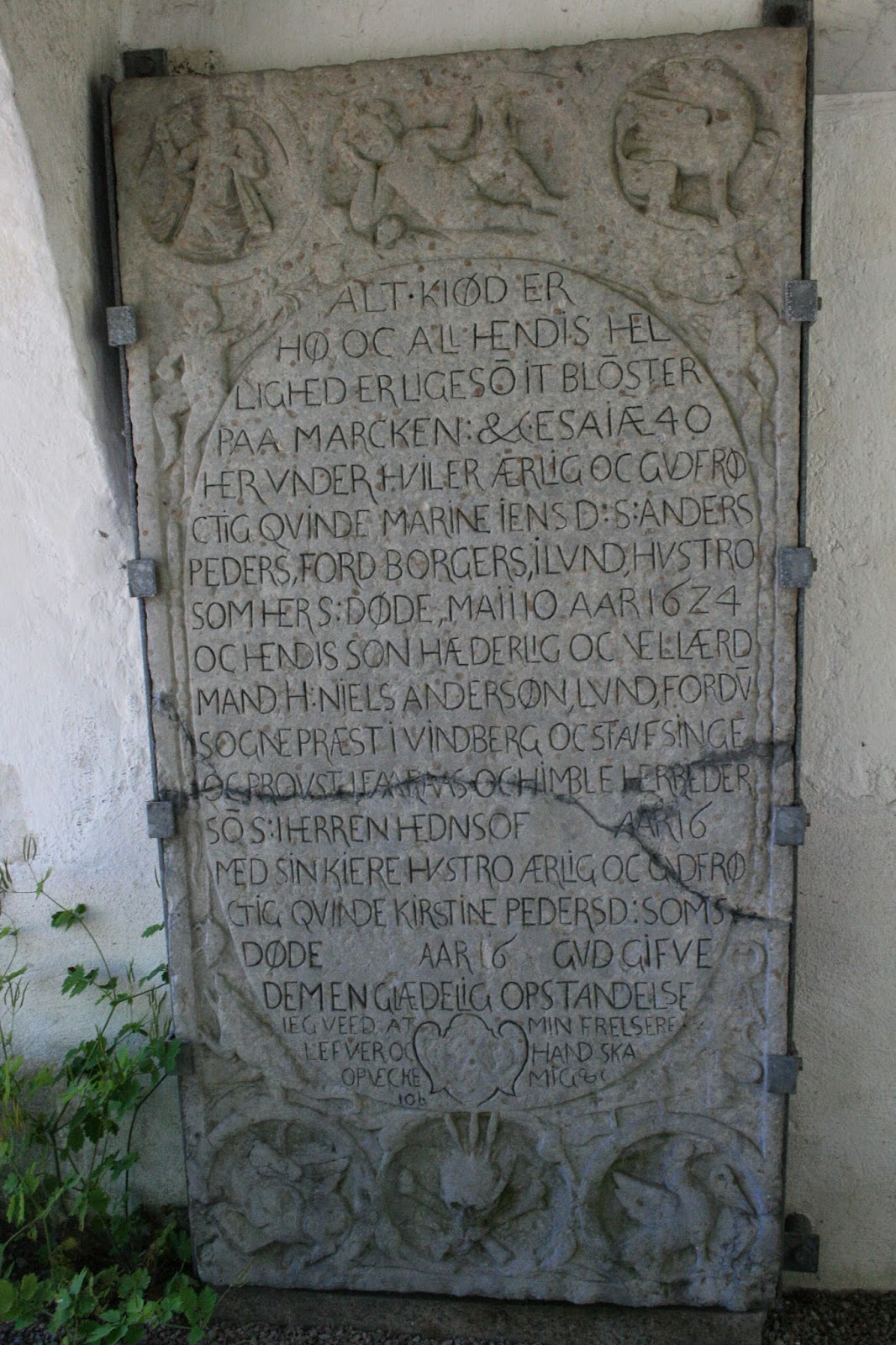
An old head-stone from 1624 when the province of Halland was Danish.

The old cemetary.

The new church in the distance.

An old water mill next to the cemetary.

List of all the head-stones and a map, showing who is buried where.
This old cemetary is a dream for any geneaologist with people buried here because in the entrance vault is a map and a file with a list of the graves and who is buried there.


Your Swedish Heritage http://linnlinns.wix.com/swedish-heritage Facebook: https://www.facebook.com/yourswedishheritage Instagram: http://instagram.com/yourswedishheritage Twitter: https://twitter.com/swedheritage Google +: https://plus.google.com/u/0/107062009006289990073/posts Pinterest: http://www.pinterest.com/urswedishherita/ Blog: http://yourswedishheritage.blogspot.se/

söndag 29 juni 2014

Crowning of Erick XIV June 29, 1561


Erik XIV was born December 13, 1533, as the oldest son of king Gustav Vasa and his mother was Katarina of Sachsen-Lauenburg. He was crowned king in the cathedral of Uppsala. His actions as king did not make his brothers or his nation happy and it led to Erik capulating to his brothers July 12, 1568. He was kept prisoner in different castles in Sweden and Finland until he died February 26, 1577, after eating pea soup. It is believed that he was poisoned by his brother Johan who had become king and research of his remains has shown that he had a high level of arsenic in his body when he died.

During his youth Eric spent a lot of time in Kalmar at the castle and it is worth a visit. There is a room that Erik partly decorated himself and he did the intarsia for the door. It was also here that he kept his mistress Agda Persdotter, which she was 1558-1561 and possibly 1563-1565. Their daughter Virginia was born in Kalmar January 1, 1559. Virginia had all the benefits of a legal child and was married to the nobleman Håkan Knutsson Hand. They lived in the parish of Odensjö in western Småland where their seven children were born and grew up. A lot of people in Sweden and all over the world are through these children related to Sweden's most famous king, Gustav Vasa. When I started with genealogy I learned about Virginia because Odensjö is where my father's father was born and grew up as a farmer's son. I thought that  maybe this would be my connection to royalty. It was not. I was very surprised when I found a connection through my mother's father who grew up in Södermanland. He came from a line of iron and marble workers and there was no knowledge about royal blood.

Erik and Agda's second daughter Constantia was born in Stockholm. Erik proposed to the queen of England, Elisabeth I but was turned down. Agda married Joakim Eriksson Frlemming but probably became Erik's mistress once again when she became a widow. All his mistresses were set aside once he met Karin Månsdotter. She was fifteen when she became his mistress and they got married July 4, 1568. They had a small quiet wedding and she was crowned queen the day after. The couple had however already gotten married in secret July 13, 1567. A lot of people were displeased with Erik's interest in Karin since she was not of noble birth but the daughter of a simple prison guard. Karin followed her husband in captivity and were freed after his death. She was given the farm Liuksiala in Finland and lived there the rest of her life.

Picture: Eric XIV of Sweden
Public Domain
By: Domenicus Verwilt
http://nationalmuseum.se/

Sources:
http://sv.wikipedia.org/wiki/Erik_XIV
http://sv.wikipedia.org/wiki/Agda_Persdotter
http://odensjohistoria.se/

Your Swedish Heritage http://linnlinns.wix.com/swedish-heritage
Facebook: https://www.facebook.com/yourswedishheritage
Instagram: http://instagram.com/yourswedishheritage
Twitter: https://twitter.com/swedheritage
Google +: https://plus.google.com/u/0/107062009006289990073/posts
Pinterest: http://www.pinterest.com/urswedishherita/

lördag 28 juni 2014

Foteviken Open Air Viking Musuem


Foteviken Museum is and Open Air Museum dedicated to the life of the vikings that lived in Scandinavia one thousand years ago.


The museum is open most days from May to September but there are special events and activities all through the year. Starting with midsummer's eve is the Viking Week at the museum. It starts with the celebration of midsummer, continues with handy craft days and ends with a four day market. The midsummer celebration and handy craft days are for vikings only. That means that you have to be part of either SVEG (Scandinavian Viking Explorer Group) or another Viking group. These people are reenacters and are the soul and spine of the activities at the market.


During the market there are contests like fish throwing, tug-of-war, tossing the caber and the bow competition "King Harolds Arrow". Many of the reenacters live in tents on the mueum grounds but some camp in tents and vans outside the area.

View of the market from the watch tower.


Somebody actually brought a bed.

Making a bow.


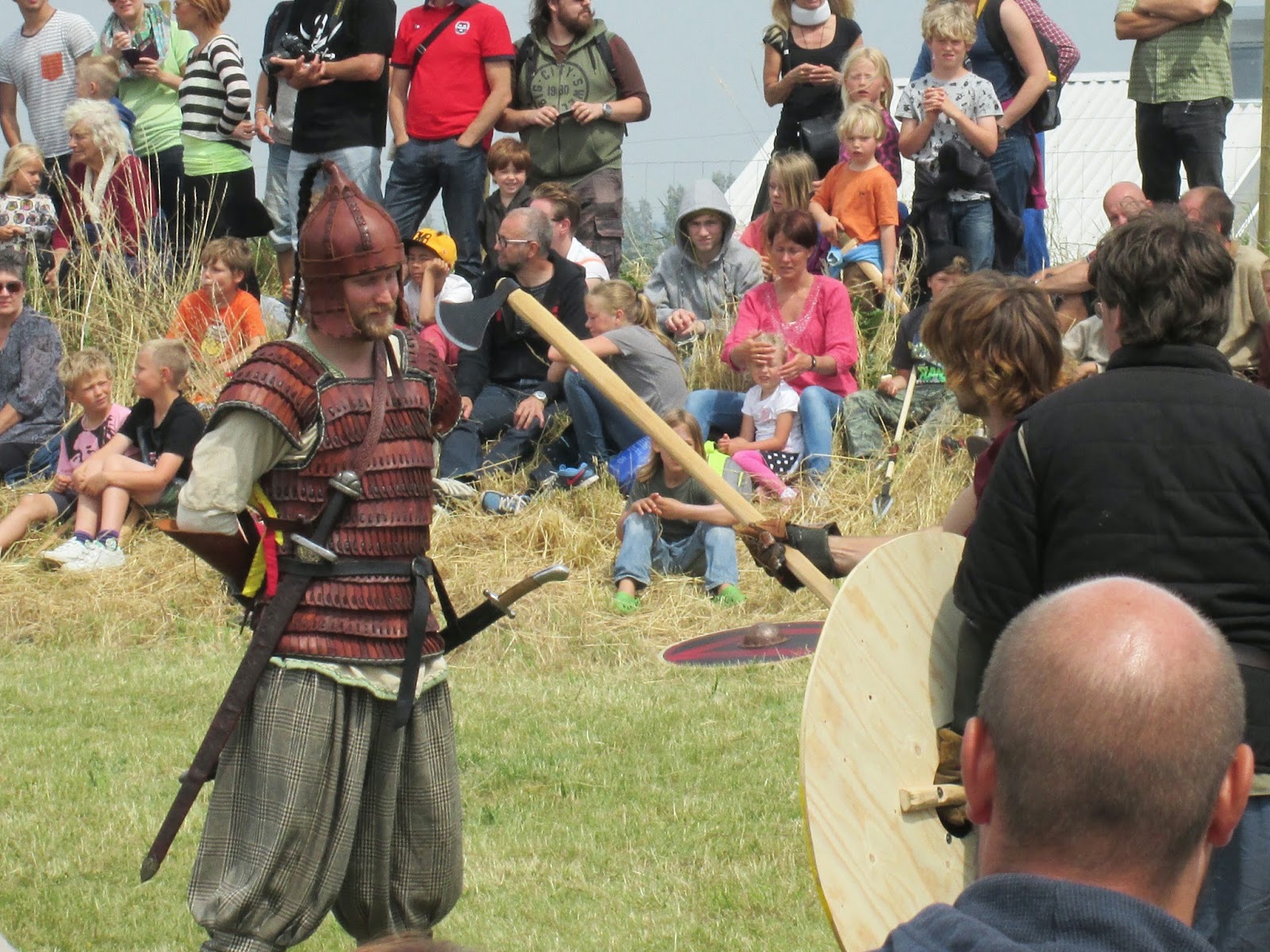
There is also a reenactment of the battle of Foteviken that took place June 4, 1134, where the Scania King Erik Emune defeated his uncle king Niels and his son Prince Magnus.


The Scania flag.


We had a wonderful day at Foteviken and I hope to return there again. Next time in full gear of my own and with my American cousins.

http://www.fotevikensmuseum.se/d/en

http://www.svegsbyalag.se/

Your Swedish Heritage http://linnlinns.wix.com/swedish-heritage Facebook: https://www.facebook.com/yourswedishheritage Instagram: http://instagram.com/yourswedishheritage Twitter: https://twitter.com/swedheritage Google +: https://plus.google.com/u/0/107062009006289990073/posts Pinterest: http://www.pinterest.com/urswedishherita/ Blog: http://yourswedishheritage.blogspot.se/

fredag 27 juni 2014

Family Reipe Friday - Brylépudding (crème caramel)


My mom always used to make crème caramel as a dessert for Christmas Eve. Here is her recipe:

Heat the oven to 175 degrees celsius.

Take
2 cups of sugar
2 tablespoons water.

Heat in a pan. Stir until the sugar has melted. Bring it to a boil until the sugar is golden brown. Poor the hot glaze in an ovenproof ovenware. Turn until the bottom and sides are compleatly covered with sugar.

Whip together:
8 dl milk
5 dl cream
3 tsp sugar
3 teaspoons vanilla sugar.

Heat all the ingredients together.

Add cold:
6 eggs
2 egg yolks

Whip the ingredients together and poor into the ovenware. Cover it with tin foil and put in a water bath in the lower half of the oven. Let it stay there for about 45 minutes. Let it cool down.

If you want to you can tip the pudding up on a plate but mom always served it as it was, in the ovenware, and that worked just fine for us.

Offical site: Your Swedish Heritage  
Facebook
Instagram
Twitter 
Google +
Pinterest

torsdag 26 juni 2014

Those Places Thursday - Varberg Coastal Sanatorium

Tuberculosis was a nationally widesperad disease at the beginning of the 20th century. Sanatoriums were built along the coast because it was believed that fresh air, salty baths and sun would cure the patients. In Varberg the medical officer was named Dr. J. S. Almer and he started the sanetarium at Apelviken, just south of Varberg, in 1902. Then it was very small but came to grow rapidly and when Almer died in 1927 it was the largest coastal sanatorium in Scandinavia with room for over 500 patients.

The hospital specialized in the sort of tuberculosis that people got from drinking milk that had not been pasturized. Small children were more often infected than grown ups and therefor it was mainly children who were treated at Apelviken. A vaccine was invented in the 1920's and in the 1950's the hospital closed as the last in the country.

Today the sanatorium has been turned into a health spa. It is protected since the enviroment is considered to be of cultural interest. Every thursday (at least during the summer months) a small guided tour is offered for free of the chapel, cemetary and outopsy room.

The chapel.

Inside the chapel.
A lot of children died at the sanatorium and not all of them were sent home. The ones buried at the cemetary are children from the most northern parts of Sweden. To send the bodies home cost too much and the parents could not afford it.

The cost of treating the patients were covered by the state, the county and the municipalities, so were the trips there and home. Some children spent years at the hospital, often in a cast when tuburculosis had gotten to the spine. Some got visits more often than others but those from the north seldom had visitors. There is a book with information about every person buried in the cemetary for those who are interested in knowing more about them.


The autopsy is right next to the cemetary. The guide explained how bodies never were moved during the day from their rooms. Instead they were transferred in the evening or early morning so that everybody would not have to see it.


Autopsy table

Autopsy table

Stretcher for moving corps and the guide.
The guide grew up in the area and knew a lot of the people working at the hospital. He himself got lung-tuberculosis as a child and spent some time at another sanatorium. He had many stories about the poeple who worked and were treated at Apelviken, both sad and happy ones.

The epedemics that reached several places all over the world during the beginning of the 20th century are hard to imagine for many of us but it is still reality in some parts of the world. It was also reality for many of our ancestors and therefor part of our personal history and genealogy.


Your Swedish Heritage http://linnlinns.wix.com/swedish-heritage
Facebook: https://www.facebook.com/yourswedishheritage
Instagram: http://instagram.com/yourswedishheritage
Twitter: https://twitter.com/swedheritage
Google +: https://plus.google.com/u/0/107062009006289990073/posts
Pinterest: http://www.pinterest.com/urswedishherita/
Blog: http://yourswedishheritage.blogspot.se/

onsdag 25 juni 2014

Summer Holidays

June 2, 1938, the Swedish government decided that every jobholder was entitled to two weeks payed. The government worried that the employees would wear out so it hade nothing to do with quality of life.

So how did people spend their holidays back then? They took the bike and went camping.

Home from the vacation 1939
In 1946 housewife could apply for the chanse go on vacation and relax for a couple of weeks. The same year all teenagers under 18 got three weeks payed vacation and from 1951 this applied to all workers. Now more and more people owned cars and Europe was explored. The first air charter took place in 1955 and it went to Majorca. Another popular country at this time was Tunisia.

Three weeks became four in 1963 and five in 1978. This is just a minimum and some have 6-7 weeks. Back in the 60's this ment that the industries all closed for four weeks and the word industrisemester (industrial holiday) was coined. Few factories can afford to close down for four weeks today so often they are spread out more even during the summer and it is quite common that people save a couple of weeks and go to Thailand during the winter.


Photo: 

Sources:
http://sv.wikipedia.org/wiki/Semester
Svenska öden & öventyr 3/2014

Your Swedish Heritage http://linnlinns.wix.com/swedish-heritage Facebook: https://www.facebook.com/yourswedishheritage Instagram: http://instagram.com/yourswedishheritage Twitter: https://twitter.com/swedheritage Google +: https://plus.google.com/u/0/107062009006289990073/posts Pinterest: http://www.pinterest.com/urswedishherita/ Blog: http://yourswedishheritage.blogspot.se/

tisdag 24 juni 2014

Tuesday's Tip - Mantalslängderna (tax/census records)

Lists from 1676, Hällestad Parish in Östergötland County

The tax/census records are lists that show how much taxes people payed. The oldest are from 1625 when Sweden were at war and there was a great need for money. The list showed all the men between the ages of 15 and 63 in every household in the parish or town. Only the name of the head of the household is mentioned and the number of people who are obligated to pay taxes. Towards the end of the 17th century the people are started to be put into categories like; man, wife, son, daughter, son-in-law, daughter-in-law, farmhand, and firmgirl. Poor and sick people could be freed from paying taxes and are therefor not mentioned.

List from Tjellmo Parish, Östergötland County, 1813-1840

The original list was kept by the district taxation register and two copies were made, one for public record office and one for the county administrative board. The originals often contain more detailed information than the copies where only sertian facts were wanted.

The tax/census records are not as detailed as the church records but can still be a lot of help to a genealogist. In the middle of the 18th century there are taxes for luxury products such as silk, tobacco, and coffe. This will give an insight to the family's economic situation. I find it very helpful when I want to know more about a farm or a village.

The tax/census recordswere kept up until 1991 and became more detailed when it came to personal facts than taxation.

Where you can find the registers online:
http://arkivdigital.net/
http://sok.riksarkivet.se/svar-digitala-forskarsalen
http://home.ancestry.com/ - I am not sure if Ancestry has the lists becuse they are not really clear on what they have.

Source:
Szabad, C. Släkthistoriskt Forum 3/2014

Your Swedish Heritage http://linnlinns.wix.com/swedish-heritage
Facebook: https://www.facebook.com/yourswedishheritage
Instagram: http://instagram.com/yourswedishheritage
Twitter: https://twitter.com/swedheritage
Google +: https://plus.google.com/u/0/107062009006289990073/posts
Pinterest: http://www.pinterest.com/urswedishherita/ Blog: http://yourswedishheritage.blogspot.se/